and all too often aren't.
So I, like everyone else, spend a lot of time playing flash games/video games/avoiding my homework in a deeply unproductive manner. However, I find myself easily bored by most time-waster games and generally unimpressed by what game designers have done with a truly fascinating medium.
Therefore, this week in lists I bring you games that are actually interesting, aesthetically motivated, and worth playing. As usual, I've tried to give my overwhelming attention to things that are a) free b) obscure, as these are probably the two most useful kinds of things I can bring to other people's attention. Also I'm avoiding things that seem obvious--yes, I love the Zelda franchise passionately, but I'm pretty sure everyone knows that they're good already.
Dungeon Crawl Stone Soup has to head this list, just because of the amount of my life I've spent playing it. It's a rougelike (if you hate links, the most important things you need to know are that there's permanent death and randomly generated settings that allow for tons of replayability) that you can download and play for free. It's, unsurprisingly, a dungeon crawl and it is a mystery to me and my friends why it's so much more engaging to us than the hundreds of other dungeon crawls out there.
Certainly the gameplay's good, but it's hardly unique. It has a tileset that makes it feel, for me, much more real than many other rougelikes in which your protagonist is often represented by an '@' symbol (I'm looking at you, Nethack). But it won't be winning any graphics competitions. I think one of my friends said it best when he described it as having "rough edges where the story was ripped out." You wake up in the dungeon, knowing nothing but that you want the Orb of Zot at the bottom. Though you-the-player don't really care much about it, you have to imagine that your character cares quite deeply and has a reason for being there. The flavor text, from the lines of a Scottish ballad that show up for all crappy, dime-a-dozen daggers [He drew his dagger, that was sae sharp/That was sae sharp and meet/And drave into the nut-browne bride/That fell deid at his feit] to the unique descriptions of each enemy, really imply that the world is full and that there's a story you're ignoring like the cold, uncaring player that you are.
It shares some of the qualities that make Nethack much-beloved, such as the presence of Nikola Tesla, Psyche, & co, and the ability to combine objects in innovative ways, but it tries to be self-consciously witty to a much lesser extent. Personally, that suits me. I like being able to take things seriously, often more so than they deserve. That said, Nethack is the only rougelike I know that is available on the iPhone, and it's free, so props to it for that. The controls are a bit clunky, but not too hard to get the hang of. And if you're an addicted enough crawler to download a rougelike to your phone, you'll play anyway.
I've never beaten the game--and I cracked and started using perma-saves (so, even though death is permanent in Dungeon Crawl, you can make a backup save folder and cheat). It's very hard, but really winning isn't where the joy comes in. The dungeon randomly reshuffles levels and monsters every time, so nothing stays the same from game to game. This makes is eminently replayable and if they ever run out of unique enemies then I haven't seen it. You can play as a bunch of different races and classes, each with their own advantages, drawbacks, and unique abilities, and you can worship a number of bizarre deities (don't choose Xom, trust me). There's a very well-maintained and thorough wiki for Dungeon Crawl that can explain the easiest and hardest characters in detail, and probably answer any questions that come up while playing.
Every Day The Same Dream is a lovely, if somewhat depressing, game. Where Dungeon Crawl is nigh-infinite, EDTSD is very short. Most things I could tell you about the game--besides the fact that it has a great score, attractive-but-simple graphics, and a philosophical angle--would ruin it. It's a small world, the goal of which is to exhaust its opportunities. At least if you insist on thinking of games as having goals, which is inadvisable.
In The Company of Myself is another drifting, philosophical game with a good soundtrack, but unlike EDTSD there is more of a sense of it being a traditional game. It runs along the fairly basic model of 'You are a little being with the ability to walk and jump. There are obstacles between you and a door at the other end of the screen. Think around them.' However, it has an interesting gameplay innovation, in which you can do a set of actions, press spacebar, and then a small clone of you will start doing what you just did ad infinitum. However, you can interact with these clones and they are necessary to completing the game. All this is coupled with the meditations of your character on his loneliness and isolation, which are very sweet and sad, and make the process of getting through doors much more weighted and unsettling.
Loved is a disturbing game. You play as a tiny little creature in a world full of the usual spikes and obstacles to climb. You're being guided, however, by an eerie narrator who gives you instructions. You can follow them or ignore them (and there are times you'd want to do both), but that changes what happens to you at the end and the world around you. Let's just say it doesn't appreciate it when you disobey. It's very sad, creepy, and cute--one of the better portrayals of a fucked-up relationship that I've seen.
Facade is the most awkward game ever. It's first-person, you play as your own gender and name (unless you choose not to), and you are going to visit a couple that you're old friends with. Their marriage is in a disastrous state and you proceed to steer your character through a painfully uncomfortable dinner party with them. What you do influences both how they react to each other and to you--I'm told you can, if you make the right decisions, help them mend their relationship. I just tend to get thrown out.
Toribash, on a totally different note, is amusing. It's free, like all of the above, and downloadable. It essentially takes an arcade fighting game and makes it a puzzle game instead. You get two very cleanly animated dolls (sort of like artists' wooden models) and can click on their individual muscles to get them to expand, contract, raise, lower, twist, etc. You see a phantom image of what your adjustments will make you doll do once they start moving and can make corrections. You hit spacebar to let them move little by little, and can continue to adjust in your efforts to hit the other doll. Whoever hits the ground first loses. You can play against an unmoving dummy to get a feel for it (it takes some practice) and then go online and fight other people. You can also save particularly awesome or hilarious fights to watch the replay.
I can sum up in one sentence why you should play Second Person Shooter Zato, even though the graphics are unprepossessing lego-things and there's no plot or anything. It's a second person shooter. There are as many split-screens as there are enemies and you look through the enemies' eyes as your shooter blows them away. I'm so glad someone actually went there.
Now we're going to get into horror, which is becoming a mini-crusade of mine because it's so pathetically represented most of the time.
It is with some trepidation that I make this next recommendation, but it has to be done. Hotel 626 and Asylum 626 are both short horror games put out by Doritos. Because somehow.....bloody, terrible death=tasty chips? I don't know. However, both of these games do some really innovative stuff with your computer and deserve to be longer, advertisement-free games. In my opinion, Asylum is the better game, although Hotel is, strictly speaking, much more of a traditional game. It's a lot easier to actually survive Hotel, for one thing, and you just plain old have more tasks to do, but it's more frustrating and less ambiently creepy.
So, you can only access both games from 6 pm until 6 am, in order to force you to play in the dark. Technically. However, I'm impatient and I cheated and set my computer clock to Moscow time and played in the middle of the day my first go around. Don't do that--I'm sure the dark makes it better. And it's duly eerie to try to log on and be told it's closed. Both games incorporate, with your permission only, your webcam and mike, and can even incorporate your phone number and facebook page if you let them. This lets your face and reactions be a part of the game, reflected in mirrors for instance, and in Hotel it cruelly forces you to try and actually sing on-key in order to lull a demon-child to sleep. The games use live action for their cut scenes, and the production values are really high. They force you to make some disturbing choices, particularly Asylum, and do the traditional visceral scare quite effectively. The only obnoxious thing is the obtrusion of the Doritos logo into the world of the game, which really only happens once. And in Asylum, there's a secret level that you can unlock either by buying their stupid chips or by spending a moment googling the correct image and printing it--you'll know what to do when you see it.
On the theme of horror, I'm going to talk about Silent Hill. For a long time. Particularly The Room (4). But I'll add that later, because I'm tired.
Saturday, April 23, 2011

Saturday, February 5, 2011
Getting to Know Your City (With a bias towards America, because you write what you know. Ususally.)
In the spirit of my major--urban history, ish?--this is a guide to getting to know the city you're in beyond the surface level of getting over misplacing North and forgetting where you park the car.
It's written with an eye to people who recently moved to a new place (and with the inevitable academic slant), but you'd be surprised how much you don't know about they city you've lived in for years. Often familiarity makes everything seem muddy and somehow inevitable--of course it's like this, it's always been that way. A closer look at the history of a neighborhood, the life of a subculture within the city, or the endless political catfight that keeps the city afloat will probably surprise you no matter how long you've lived there--and possibly give you a grip on the issues in time for the next election.

1. Look as a map of the city, on google maps. Play with the street view. Find a public transit map. Know that while it will be very accurate, digital mapping has its weaknesses and even the all-mighty google will fail to show you everything perfectly. Also google the city's skyline, and look at the different images people have of the city. What do they think it's like? What's the general aesthetic, or the cliche?
2. Take a walk. A long one, through several blocks. Look at the buildings there and think about how they got to be that way--what style of architecture it is, what it tells you about the historical development of that neighborhood, whether it's residential or retail and why, what economic strata it's in, how long it's looked this way. Read the fliers posted on walls and streetlights and see what people in the area care about. Look at the graffiti.
3. When you're done, go look up the local neighborhood historical society, if there is one, and find out if you were right. Which houses were made in the 19th century? When did the park get put in? How long has the area been part of the city?
4. Scope out the coffee shops in your neighborhood. Notice what kind of people eat at which restaurants. Go to that place you never eat at and try and figure out why you haven't been before.

5. See the cliches, all of them, because there's a reason tourists do that, and actually read the historical displays next to them.
6. If this city is west of the first thirteen colonies, look up its plat map online (For example, Cook County i.e. Chicago). You might try and find a secondary source that explains the plat map too--the interesting part is in understanding the quirks of how the city was first laid out.
Westward expansion in the U.S. was highly regimented, contrary to popular belief. Land was divided up in grid patterns, often with the same exact rectangle set aside for the same purpose in many different cities. One of the earlier patterns in Ohio, for instance, always had the same numbered lot earmarked as a school. Land was sold in plats to private owners, who often later subdivided them for further profit. A lot about how the city later came to be shaped was dictated by these plat maps and by how their first owners decided to develop them.
Also, the insanity of many cities' street layouts can be explained by the fact that landowners could put in streets however they wanted--they didn't have to hook them up to everyone else's. It also helped that the grids were often laid down with scant regard for actual local topography, creating awkward patches and irregular corners where elevation, marsh, rivers, or other geographical features interfered.

7. Pick a restaurant that serves a regional cuisine you rarely eat, and go to that neighborhood to eat it. For example, Chinatown, Divan, Little Italy, Germantown, whatever. Chicago is spoiled in this regard, but most cities have small ethnic enclaves like this--for instance the Ethiopian restaurants and stores in Washington D.C. Order something you don't recognize, or ask the waiter for a recommendation. Bonus points if you're entirely unsure how to eat it.
8. Look up the city government web page, and scan the constitution. Strong city council or strong mayor? Note that often the constitution's intent doesn't work out--in theory Chicago has a strong council and a weak mayor. In practice? Well.....yeah.
(Fun Chicago exercise--check the last names on political figures of the last century from ward captain up through state senator and see how many of the last names are the same. I have a haunting feeling this will be interesting for many other cities as well.)
8. Read the local paper. Where does the power lie politically, in the state legislature or the city government? The governor? Attorney general? A mayor or the majority party's leader? What issues is the city concerned about? Space? Garbage disposal? Crime? You won't get this from the government web page (well, maybe you will, but they can be hard to squeeze real meaning from if you don't already know a good bit about the city), but you will get this from newspapers, op eds, forums, and the comments section on articles. The Politics section of The Commercial Appeal is a good example for the city of Memphis. Like all papers, it has a slant, but the articles and comments beneath them still give a good snapshot of the city officials and citizens' relationship.
The example I gave was of a particularly mainstream local paper, but specialty papers--say for entertainment-only, or LGBTQ papers, or radical political papers--also have a lot to say, with more detail if less breadth.

9. If there's a public transit system, pick a bus or train line and ride it from one end to another. If not, go for a long drive to nowhere in particular.
10. The census makes maps nowadays. The 2010 data is coming on a rolling basis, so more and more states are going to appear. In the meantime, these are based on samples from 2005-9. Or there's quick facts if you're not the visual type. Old census data can be interesting too, for the contrast it makes with the present (though I recognize people not inherently fascinated by history and demographic shifts might not want to wade through too much data. Still, having a quick glance can be enlightening if you want to know how the city's changed).
11. Your city, chances are, has a restaurant week, during which the swankiest places to eat in the city offer prix-fixe three course meals, that would normally cost a hundred dollars or more, for somewhere between twenty and thirty-five dollars. You might want to get a reservation in advance, but it will be well worth it. Most cities have a website or somewhere participating restaurants are listed, and it will give you a good idea of what food culture is like in the city. It will also be delicious without impoverishing you.
12. Go to museums. Not just the big natural history/art museum, though you should go to those too. Go to the Textile Museum, or the Audubon Museum, the Museum of Contemporary Photography, or the Fire Museum of Greater Chicago (I've never been to the latter, it's new, but only good can come of it). Little out-of-the-way places like that usually are dedicated to a local luminary, or manufacturing product, or are just about a subject that a small group of people in the area really cared about.

13. Go drawing/painting/photographing in an area of the city. Don't let lack of artistic inclination stop you--it'll give you a new way of looking at where you are. While you're at it, look at other people's paintings/drawings/photos of the city. What does everyone's eyes seem drawn to?
14. While you're in an artsy mode, find the art galleries. Most cities have a district spotted with small, local art galleries. What's the scene like where you are? Bookstores are also often good for poetry readings, local authors giving talks, that kind of thing. Any universities/colleges nearby will also be full of odd little events, though inevitably they will be somewhat less local in character.
It's written with an eye to people who recently moved to a new place (and with the inevitable academic slant), but you'd be surprised how much you don't know about they city you've lived in for years. Often familiarity makes everything seem muddy and somehow inevitable--of course it's like this, it's always been that way. A closer look at the history of a neighborhood, the life of a subculture within the city, or the endless political catfight that keeps the city afloat will probably surprise you no matter how long you've lived there--and possibly give you a grip on the issues in time for the next election.
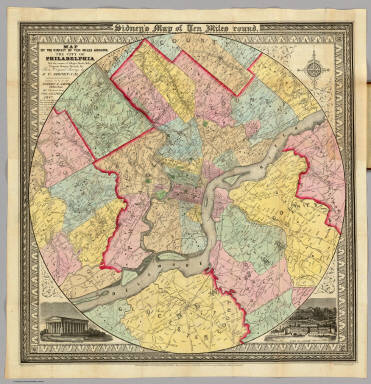
Image from: http://www.davidrumsey.com/maps492.html
1. Look as a map of the city, on google maps. Play with the street view. Find a public transit map. Know that while it will be very accurate, digital mapping has its weaknesses and even the all-mighty google will fail to show you everything perfectly. Also google the city's skyline, and look at the different images people have of the city. What do they think it's like? What's the general aesthetic, or the cliche?
2. Take a walk. A long one, through several blocks. Look at the buildings there and think about how they got to be that way--what style of architecture it is, what it tells you about the historical development of that neighborhood, whether it's residential or retail and why, what economic strata it's in, how long it's looked this way. Read the fliers posted on walls and streetlights and see what people in the area care about. Look at the graffiti.
3. When you're done, go look up the local neighborhood historical society, if there is one, and find out if you were right. Which houses were made in the 19th century? When did the park get put in? How long has the area been part of the city?
4. Scope out the coffee shops in your neighborhood. Notice what kind of people eat at which restaurants. Go to that place you never eat at and try and figure out why you haven't been before.

Image from: http://www.cynic.org.uk/holidays/nyc2002/
5. See the cliches, all of them, because there's a reason tourists do that, and actually read the historical displays next to them.
6. If this city is west of the first thirteen colonies, look up its plat map online (For example, Cook County i.e. Chicago). You might try and find a secondary source that explains the plat map too--the interesting part is in understanding the quirks of how the city was first laid out.
Westward expansion in the U.S. was highly regimented, contrary to popular belief. Land was divided up in grid patterns, often with the same exact rectangle set aside for the same purpose in many different cities. One of the earlier patterns in Ohio, for instance, always had the same numbered lot earmarked as a school. Land was sold in plats to private owners, who often later subdivided them for further profit. A lot about how the city later came to be shaped was dictated by these plat maps and by how their first owners decided to develop them.
Also, the insanity of many cities' street layouts can be explained by the fact that landowners could put in streets however they wanted--they didn't have to hook them up to everyone else's. It also helped that the grids were often laid down with scant regard for actual local topography, creating awkward patches and irregular corners where elevation, marsh, rivers, or other geographical features interfered.
Now, most eastern cities were just laid out ad hoc according to the needs of the colonists, but there are sometimes sites like Bostonography or archives of various universities that will still contain maps of all kinds of eastern cities in various stages and through various lenses throughout their history.

Image from: http://www.flickr.com/people/sarahhsia/
7. Pick a restaurant that serves a regional cuisine you rarely eat, and go to that neighborhood to eat it. For example, Chinatown, Divan, Little Italy, Germantown, whatever. Chicago is spoiled in this regard, but most cities have small ethnic enclaves like this--for instance the Ethiopian restaurants and stores in Washington D.C. Order something you don't recognize, or ask the waiter for a recommendation. Bonus points if you're entirely unsure how to eat it.
8. Look up the city government web page, and scan the constitution. Strong city council or strong mayor? Note that often the constitution's intent doesn't work out--in theory Chicago has a strong council and a weak mayor. In practice? Well.....yeah.
(Fun Chicago exercise--check the last names on political figures of the last century from ward captain up through state senator and see how many of the last names are the same. I have a haunting feeling this will be interesting for many other cities as well.)
8. Read the local paper. Where does the power lie politically, in the state legislature or the city government? The governor? Attorney general? A mayor or the majority party's leader? What issues is the city concerned about? Space? Garbage disposal? Crime? You won't get this from the government web page (well, maybe you will, but they can be hard to squeeze real meaning from if you don't already know a good bit about the city), but you will get this from newspapers, op eds, forums, and the comments section on articles. The Politics section of The Commercial Appeal is a good example for the city of Memphis. Like all papers, it has a slant, but the articles and comments beneath them still give a good snapshot of the city officials and citizens' relationship.
The example I gave was of a particularly mainstream local paper, but specialty papers--say for entertainment-only, or LGBTQ papers, or radical political papers--also have a lot to say, with more detail if less breadth.

Image from: http://www.flickr.com/people/swanksalot/
9. If there's a public transit system, pick a bus or train line and ride it from one end to another. If not, go for a long drive to nowhere in particular.
10. The census makes maps nowadays. The 2010 data is coming on a rolling basis, so more and more states are going to appear. In the meantime, these are based on samples from 2005-9. Or there's quick facts if you're not the visual type. Old census data can be interesting too, for the contrast it makes with the present (though I recognize people not inherently fascinated by history and demographic shifts might not want to wade through too much data. Still, having a quick glance can be enlightening if you want to know how the city's changed).
11. Your city, chances are, has a restaurant week, during which the swankiest places to eat in the city offer prix-fixe three course meals, that would normally cost a hundred dollars or more, for somewhere between twenty and thirty-five dollars. You might want to get a reservation in advance, but it will be well worth it. Most cities have a website or somewhere participating restaurants are listed, and it will give you a good idea of what food culture is like in the city. It will also be delicious without impoverishing you.
12. Go to museums. Not just the big natural history/art museum, though you should go to those too. Go to the Textile Museum, or the Audubon Museum, the Museum of Contemporary Photography, or the Fire Museum of Greater Chicago (I've never been to the latter, it's new, but only good can come of it). Little out-of-the-way places like that usually are dedicated to a local luminary, or manufacturing product, or are just about a subject that a small group of people in the area really cared about.

Image from: http://si.smugmug.com/gallery/1674201/1/121703751_wHHGg#121703751_wHHGg
13. Go drawing/painting/photographing in an area of the city. Don't let lack of artistic inclination stop you--it'll give you a new way of looking at where you are. While you're at it, look at other people's paintings/drawings/photos of the city. What does everyone's eyes seem drawn to?
14. While you're in an artsy mode, find the art galleries. Most cities have a district spotted with small, local art galleries. What's the scene like where you are? Bookstores are also often good for poetry readings, local authors giving talks, that kind of thing. Any universities/colleges nearby will also be full of odd little events, though inevitably they will be somewhat less local in character.
Thursday, January 13, 2011
Literary Journals
So! I'm in a Creative Fiction class and, in its own way, its redirected me to the theoretical purpose of this blog. As part of the class, since its purpose is to prepare us for publication as really real writers, we've been reviewing/presenting on literary journals. Now, as someone who has considered themselves a writer (albeit an extremely retiring one) for a very long time, it's something of a schande that I knew very little about the journals that were out there or how they work.
Still, everyone has to start somewhere and, since I'm doing it already, I thought I'd put up links to some random journals that a) are excellent b) are particularly wonky and c) are small/obscure/indie/interested/whatever enough that previously unpublished authors have a good shot at getting into them.
I also have a preference for journals that won't charge you a fee for reading your work, as I know everyone's broke, but some of the best ones do and there'll be a couple of them on the list too. Now, most of these journals also won't pay you, but those that put out print additions often send the author a complementary copy of the issue their piece appeared in.
Edit: I'm going to separate these into two sections, based broadly on distribution size and big deal-ness, so that some of the heavy hitters are on here too. Those in the Wonky section vary in size, but those in the Big section are 'you've made it kid' likely-to-be-carried-in-bookstores kind of publications.
Also, Duotrope.com is your friend. It has a huge database of journals, searchable by most things an author would care about, and gives you access to acceptance and response time statistics. It also lets you keep track of your impending submissions all in one place.
Wonky
Naturally, I must open this list with Bust Down The Door And Eat All The Chickens, a journal of absurd and surreal work. They like funny, they don't want surreal mistaken for fantasy, and they're not super into horror. You can download their issues for free from their website, and you should.
Next is 5x5 a journal that is, when in print, five inches by five inches. They took the name from radio jargon meaning "the signal had excellent strength and perfect clarity", and that's their literary mission statement. They take everything--poetry, fiction, non-fiction, comics, art--and they have themes for each issue posted on their website. They encourage high schoolers and the under-eighteen crowd to submit, so it's a great place for precious writers to use as a springboard.
BAP Quarterly is a little less off-beat than the first two, but I like what I've seen of it so far. It also has a different theme each issue and accepts fiction, non-fiction, poetry, and photography. It's in a more conventional journal format, slickly presented, and it's also available for free online.
Cafe Irreal is another surreal (or irreal, I suppose, they have a lengthy section defining that) journal, perhaps a little more reflective, refined, and mellow than Chickens. It also gets submissions from previously published authors sometimes and, of all things, pays the author actual money for first-publish internet rights, so that's good.
Not gonna lie, Booth Journal is on this list entirely because What They Did With The Body was such a bizarre, excellent, upsetting story. All their stories are that well-chosen though, as far as I can see. Also, the editors' tone is endearingly offbeat in a way that doesn't fill me with rage at hipsters. They take poetry, fiction, nonfiction, comics, and lists and are more excited about the last three because they get less of them. Personally, I'm really pleased by the idea of submitting lists, as grouping information is oddly interesting and aesthetically cool. Some of their lists are pretty great.
Weird Tales is taking up the mantle of the original Weird Tales, that was founded in the 1920s and gave Lovecraft his start. They publish weird, speculative, alt fiction, poetry, and one-minute videos that are "sort of a funky hybrid of a movie trailer, a Zen koan, and an Adult Swim between-show bumper". They pay you 5 cents a word for fiction and twenty dollars a poem. They also have a section called Weird Sightings, where they put up strange or amusing things related to Lovecraft.
The Liar's League is awesome. They take flash fiction and short stories (800-2000 words) and have actors read them aloud regularly at performances. Now, they're based in London, so a lot of us *cough* can't go watch, but they upload recordings to their website and to iTunes.
365 Tomorrows is not actually journal-level stuff, but it is kind of fun and a good place to experiment. It's a science fiction flash fiction site, where one incredibly short story goes up on the front page per day. That means there's lots of chances to get in, and on a separate note it's a great place for a reader to get a quick and often-bizarre sci-fi fix. On a totally self-promoting note, this one time I had a story in it and was really pleased with myself.
The Kunlun Journal of Chinese Historical Fiction is a fledgling journal, but I love highly specific niche publications, especially when that niche is wuxia. And there aren't enough historical fiction journals out there.
So I'm also going to include Lacuna, a historical fiction journal of discerning taste that takes work set in all time periods and locations, and Alt Hist, an alternate history journal--because really, not enough people love alternate histories.
Big
Glimmer Train actually charges a reading fee for stories you submit and has a wider circulation than the stuff in the previous section. It takes stories from published and unpublished writers alike, and tends to be a pretty good spot to get noticed by an agent from. That said, it also treats its authors very well, gives them a lot of attention, has regular competitions with substantial prizes, and has a pretty classy format. The journal is also not available online/free and don't take novels, poetry, or kids' stories. They like stories that focus on the human element, and emotional significance. Also--someone in my class totally just got a story accepted into their most recent issue. There was no point to telling you except that it was awesome.
Tin House has themed issues, accepts submissions from September 1 to May 31, and publishes in a really nice paperback format that's carried by a lot of bookstores. They have a hard 10,000 word limit on stories and take up to five poems at a time. They also include a crossword, restaurant and book reviews, and other magazine features in their issues. The published well-known authors next to unpublished ones, and are committed to include at least one unpublished author in each issue.
McSweeney's Quarterly is avante garde! Off-beat! Very well known! And very hard to get into. They publish books as well and have a whole host of literary things associated with them. They publish authors you wouldn't expect, like David Byrne from the Talking Heads, the the whole thing is Dave Eggers' ("A Heartbreaking Work of Staggering Genius") brainchild. Their response time, however, is one of the worst in the business, sometimes taking an entire year.
The New Yorker really needs no introduction and it's included for completeness' sake, but it's kind of at the apex of journals and you've pretty well made it if you get accepted here. It was basically my childhood.
Clarksworld Magazine is one of the speculative fiction (scifi and fantasy) heavy-hitters. Hard to get into, pays at professional rates, and accepts fiction with 1,000 to 8,000 words, though it prefers them to be right in the middle. They have a fairly exhaustive list of pet-peeves in their submission section, most of which are quite reasonable, that are worth checking out before you submit.
Still, everyone has to start somewhere and, since I'm doing it already, I thought I'd put up links to some random journals that a) are excellent b) are particularly wonky and c) are small/obscure/indie/interested/whatever enough that previously unpublished authors have a good shot at getting into them.
I also have a preference for journals that won't charge you a fee for reading your work, as I know everyone's broke, but some of the best ones do and there'll be a couple of them on the list too. Now, most of these journals also won't pay you, but those that put out print additions often send the author a complementary copy of the issue their piece appeared in.
Edit: I'm going to separate these into two sections, based broadly on distribution size and big deal-ness, so that some of the heavy hitters are on here too. Those in the Wonky section vary in size, but those in the Big section are 'you've made it kid' likely-to-be-carried-in-bookstores kind of publications.
Also, Duotrope.com is your friend. It has a huge database of journals, searchable by most things an author would care about, and gives you access to acceptance and response time statistics. It also lets you keep track of your impending submissions all in one place.
Wonky
Naturally, I must open this list with Bust Down The Door And Eat All The Chickens, a journal of absurd and surreal work. They like funny, they don't want surreal mistaken for fantasy, and they're not super into horror. You can download their issues for free from their website, and you should.
Next is 5x5 a journal that is, when in print, five inches by five inches. They took the name from radio jargon meaning "the signal had excellent strength and perfect clarity", and that's their literary mission statement. They take everything--poetry, fiction, non-fiction, comics, art--and they have themes for each issue posted on their website. They encourage high schoolers and the under-eighteen crowd to submit, so it's a great place for precious writers to use as a springboard.
BAP Quarterly is a little less off-beat than the first two, but I like what I've seen of it so far. It also has a different theme each issue and accepts fiction, non-fiction, poetry, and photography. It's in a more conventional journal format, slickly presented, and it's also available for free online.
Cafe Irreal is another surreal (or irreal, I suppose, they have a lengthy section defining that) journal, perhaps a little more reflective, refined, and mellow than Chickens. It also gets submissions from previously published authors sometimes and, of all things, pays the author actual money for first-publish internet rights, so that's good.
Not gonna lie, Booth Journal is on this list entirely because What They Did With The Body was such a bizarre, excellent, upsetting story. All their stories are that well-chosen though, as far as I can see. Also, the editors' tone is endearingly offbeat in a way that doesn't fill me with rage at hipsters. They take poetry, fiction, nonfiction, comics, and lists and are more excited about the last three because they get less of them. Personally, I'm really pleased by the idea of submitting lists, as grouping information is oddly interesting and aesthetically cool. Some of their lists are pretty great.
Weird Tales is taking up the mantle of the original Weird Tales, that was founded in the 1920s and gave Lovecraft his start. They publish weird, speculative, alt fiction, poetry, and one-minute videos that are "sort of a funky hybrid of a movie trailer, a Zen koan, and an Adult Swim between-show bumper". They pay you 5 cents a word for fiction and twenty dollars a poem. They also have a section called Weird Sightings, where they put up strange or amusing things related to Lovecraft.
The Liar's League is awesome. They take flash fiction and short stories (800-2000 words) and have actors read them aloud regularly at performances. Now, they're based in London, so a lot of us *cough* can't go watch, but they upload recordings to their website and to iTunes.
365 Tomorrows is not actually journal-level stuff, but it is kind of fun and a good place to experiment. It's a science fiction flash fiction site, where one incredibly short story goes up on the front page per day. That means there's lots of chances to get in, and on a separate note it's a great place for a reader to get a quick and often-bizarre sci-fi fix. On a totally self-promoting note, this one time I had a story in it and was really pleased with myself.
The Kunlun Journal of Chinese Historical Fiction is a fledgling journal, but I love highly specific niche publications, especially when that niche is wuxia. And there aren't enough historical fiction journals out there.
So I'm also going to include Lacuna, a historical fiction journal of discerning taste that takes work set in all time periods and locations, and Alt Hist, an alternate history journal--because really, not enough people love alternate histories.
Big
Glimmer Train actually charges a reading fee for stories you submit and has a wider circulation than the stuff in the previous section. It takes stories from published and unpublished writers alike, and tends to be a pretty good spot to get noticed by an agent from. That said, it also treats its authors very well, gives them a lot of attention, has regular competitions with substantial prizes, and has a pretty classy format. The journal is also not available online/free and don't take novels, poetry, or kids' stories. They like stories that focus on the human element, and emotional significance. Also--someone in my class totally just got a story accepted into their most recent issue. There was no point to telling you except that it was awesome.
Tin House has themed issues, accepts submissions from September 1 to May 31, and publishes in a really nice paperback format that's carried by a lot of bookstores. They have a hard 10,000 word limit on stories and take up to five poems at a time. They also include a crossword, restaurant and book reviews, and other magazine features in their issues. The published well-known authors next to unpublished ones, and are committed to include at least one unpublished author in each issue.
McSweeney's Quarterly is avante garde! Off-beat! Very well known! And very hard to get into. They publish books as well and have a whole host of literary things associated with them. They publish authors you wouldn't expect, like David Byrne from the Talking Heads, the the whole thing is Dave Eggers' ("A Heartbreaking Work of Staggering Genius") brainchild. Their response time, however, is one of the worst in the business, sometimes taking an entire year.
The New Yorker really needs no introduction and it's included for completeness' sake, but it's kind of at the apex of journals and you've pretty well made it if you get accepted here. It was basically my childhood.
Clarksworld Magazine is one of the speculative fiction (scifi and fantasy) heavy-hitters. Hard to get into, pays at professional rates, and accepts fiction with 1,000 to 8,000 words, though it prefers them to be right in the middle. They have a fairly exhaustive list of pet-peeves in their submission section, most of which are quite reasonable, that are worth checking out before you submit.
Wednesday, December 15, 2010
So Apparently This Blog is For RPGs Now (Fiasco Playset for 19th Century Japan)
Apparently I've given up on the whole "research aid, look at me be scholarly" thing, and am just putting up RPG-related stuff now. That said, here's the playset I finished writing up recently for Jason Morningstar's excellent rpg Fiasco. It's set in my most recent pet obsession, Yokohama Japan, during the treaty port era when everything was crazy.
Google docs destroys all my pretty formatting, but it's what I have to work with here.
I present: A Fiasco in 1865 Yokohama
Google docs destroys all my pretty formatting, but it's what I have to work with here.
I present: A Fiasco in 1865 Yokohama
Saturday, September 18, 2010
Walkers in The Witchery Way (RPG)
So this isn't what the blog's theoretically for, but I've been working on an RPG recently and I needed somewhere to post it anyway--so here goes.
Link to the Google Doc
In terms of game-feel and mechanics it owes a lot to Polaris, In a Wicked Age, Don't Rest Your Head, Dread, Apocalypse World, and the endless discussions about RPGs with my various excellent and similarly obsessed friends. I'm going for simple rules--perhaps too simple?--but I think it fits the atmosphere I'm trying to create for the game. And I'm trying to fight my overwhelming urge to map every detail out a la' Shadowrun.
Story-wise, I took a lot from Native American mythology, but am going for an ambiguous hyphenation between that and a sort of Middle-Eastern "cradle-of-civilization" feel. The goal of the game is flexibility, both for characters and for the kind of story--characters shift from one thing to another, characters' goals and motives in the game can just as easily be played by someone else in the inverse, that sort of thing. I like the idea of characters that are very fluid in limited terms but never change for good, never advance or increase, but just keep making new mistakes.
EDIT: So, I changed the rules a bit and streamlined/fleshed out things (I hope) in response to the critiques from Gamechef and various of my friends who looked it over. I'm also adding a decent bestiary and GM repository, to make it easier to kick-start a game.
Link to the Google Doc
In terms of game-feel and mechanics it owes a lot to Polaris, In a Wicked Age, Don't Rest Your Head, Dread, Apocalypse World, and the endless discussions about RPGs with my various excellent and similarly obsessed friends. I'm going for simple rules--perhaps too simple?--but I think it fits the atmosphere I'm trying to create for the game. And I'm trying to fight my overwhelming urge to map every detail out a la' Shadowrun.
Story-wise, I took a lot from Native American mythology, but am going for an ambiguous hyphenation between that and a sort of Middle-Eastern "cradle-of-civilization" feel. The goal of the game is flexibility, both for characters and for the kind of story--characters shift from one thing to another, characters' goals and motives in the game can just as easily be played by someone else in the inverse, that sort of thing. I like the idea of characters that are very fluid in limited terms but never change for good, never advance or increase, but just keep making new mistakes.
EDIT: So, I changed the rules a bit and streamlined/fleshed out things (I hope) in response to the critiques from Gamechef and various of my friends who looked it over. I'm also adding a decent bestiary and GM repository, to make it easier to kick-start a game.
Sunday, August 8, 2010
So hi.
The theory of this blog, at the moment, is to make a research resource archive (tongue twister) targeted vaguely towards college and up and to give us a forum to kick around ideas.
"We" are three undergraduates studying American history, math (computability theory and reverse math), and neuroscience with a minor in computer science. So there should be a wide variety of topics floating around.
So, I'm vaguely obsessed with video/oral-history right now, partly due to work. My focus in history is mostly on urban history, particularly Chicago. There's a lot of great material in film and video on Chicago, most of it very underrated. Below are a couple of sites I've been hanging out on a lot lately and would recommend, particularly since they have a lot of information that would still be useful for broader research.
The HistoryMakers
An Chicago-based oral history archive composed of interviews with African Americas from around the country. It's broken up by categories (ScienceMaker, LawMaker, that kind of thing).
You have to register to use the site, because it's still in a testing phase, but they don't email you about it and you only have to answer a couple of questions about why you're interested. They have a lot more material online in written biographies than they do in interviews, but there's a lot more information in the interviews. What you see is what you get with this site, as they haven't yet opened up their physical archive yet.
The HistoryMakers
MediaBurn
So in the late 1960s the advent of portable video cameras sparked a movement of independent video makers in Chicago. Many of them were politically motivated, though a lot were also just about aesthetic creativity. MediaBurn is an archive of video clips made during that time, almost all by independent artists.
Incidentally, the site took its name from a counterculture event in which a guy drove a burning Cadillac through a mountain of televisions, a clip that is well worth watching. MediaBurn is run by a bunch of former members of the indie video movement, so it's very well-cared for. Chicago was having an interesting time, to say the least, during this period, and MediaBurn has some pretty unique information about that time.
MediaBurn
StoryCorps
StoryCorps is an interesting one--it's an oral history project that's basically open to anyone who wants to record a clip. It's based around two people who are close, say father and son or two best friends, doing an interview with each other. They give people who do the interviews a CD of it and broadcast segments on NPR as well as posting a lot of them on the site.
The clips tend to be short, and they range from poignant human-interest stuff to pretty historically interesting recollections, such as one man's witnessing of the Stonewall riot.
StoryCorps
National Visionary Leadership Project
It's not quite as thorough or wide in scope as The HistoryMakers, but it's similar in a lot of ways. They also have some content the HMs don't.
The Visionary Project
"We" are three undergraduates studying American history, math (computability theory and reverse math), and neuroscience with a minor in computer science. So there should be a wide variety of topics floating around.
So, I'm vaguely obsessed with video/oral-history right now, partly due to work. My focus in history is mostly on urban history, particularly Chicago. There's a lot of great material in film and video on Chicago, most of it very underrated. Below are a couple of sites I've been hanging out on a lot lately and would recommend, particularly since they have a lot of information that would still be useful for broader research.
The HistoryMakers
An Chicago-based oral history archive composed of interviews with African Americas from around the country. It's broken up by categories (ScienceMaker, LawMaker, that kind of thing).
You have to register to use the site, because it's still in a testing phase, but they don't email you about it and you only have to answer a couple of questions about why you're interested. They have a lot more material online in written biographies than they do in interviews, but there's a lot more information in the interviews. What you see is what you get with this site, as they haven't yet opened up their physical archive yet.
The HistoryMakers
MediaBurn
So in the late 1960s the advent of portable video cameras sparked a movement of independent video makers in Chicago. Many of them were politically motivated, though a lot were also just about aesthetic creativity. MediaBurn is an archive of video clips made during that time, almost all by independent artists.
Incidentally, the site took its name from a counterculture event in which a guy drove a burning Cadillac through a mountain of televisions, a clip that is well worth watching. MediaBurn is run by a bunch of former members of the indie video movement, so it's very well-cared for. Chicago was having an interesting time, to say the least, during this period, and MediaBurn has some pretty unique information about that time.
MediaBurn
StoryCorps
StoryCorps is an interesting one--it's an oral history project that's basically open to anyone who wants to record a clip. It's based around two people who are close, say father and son or two best friends, doing an interview with each other. They give people who do the interviews a CD of it and broadcast segments on NPR as well as posting a lot of them on the site.
The clips tend to be short, and they range from poignant human-interest stuff to pretty historically interesting recollections, such as one man's witnessing of the Stonewall riot.
StoryCorps
National Visionary Leadership Project
It's not quite as thorough or wide in scope as The HistoryMakers, but it's similar in a lot of ways. They also have some content the HMs don't.
The Visionary Project
Subscribe to:
Posts (Atom)